North Vancouver and West Vancouver do not hand us the same job. On the North Vancouver side the master key work is overwhelmingly strata and multi-tenant: mid-rise and tower stock along Lonsdale, townhome complexes in Lynn Valley and Lynnmour, small office buildings off St. Georges. In West Vancouver it is more often one owner with several doors that matter. What decides the system in either case is not the address. It is which cylinders on the site can actually hold a hierarchy, and whether anyone still has a record of the keys already out there.
Which North Shore doors can carry a hierarchy
A master key system is a pinning plan, so the constraint is the cylinder rather than the building. Some North Shore doors are ruled in or out before a price is worth discussing, and the walkthrough exists to find that out early.
Two belts of stock share one problem. The concrete mid-rises that sit on 2nd Avenue and 1st, between St. Georges and Lonsdale, and the two-storey townhome stratas of Cedar Street and Fir Street over in Lynnmour, both hold cylinders repinned through thirty years of tenancies. Enough of them have gone loose at the plug, or turned gummy and prone to binding, that the walkthrough checks rather than assumes, because neither is a sound starting point for a lock that now has to answer to two different keys. A plug that no longer pins out securely comes off the plan and gets replaced rather than carried into it.
Two smaller cases come up often enough here to name. An older Lynnmour townhome with a passage latch on the same door as the deadbolt has two cylinders to pin, which is two pinnings and two positions in the chart, not one. And some of the single-family homes around Quinn Street still carry a knob and latch with no deadbolt fitted at all, so there is nothing on that door to key until one goes in. Older detached stock in Upper Lonsdale, and the post-war bungalows and split-levels of Edgemont Village, raise the opposite question: a hierarchy is key control, not security, so a dated single-cylinder deadbolt with little pick resistance is still a weak door after it joins the system. Where that comes up, the right move is a lock change to a Grade 1 deadbolt first and the pinning second.
What a master key system includes
- A walkthrough of every door on the site, with the access map agreed before anything is ordered
- The hierarchy on paper: change keys per unit, a master over each group, a grand master where more than one group exists
- Restricted keyway selection where key control matters, so copies are cut on written authorization rather than at a kiosk
- Cylinder supply and installation, or re-pinning where the existing hardware is sound
- Every key tested against the chart on site before it is handed over
- A key register: how many keys exist, which level each one sits on, and who signed for it
- The install documented for strata council records where the building keeps its own
- Later additions on the same system: a new suite, a replacement key, a level retired
Master key system pricing in North Vancouver
Two things set the number and neither of them is the postal code. Door count is the obvious one. The second is how much of the existing hardware survives the walkthrough, because a site where most cylinders can be re-pinned prices very differently from one where they come off the door. Keyway choice moves the schedule more than the total: we stock and cut the restricted profiles we carry on the truck, and one we do not carry has to be ordered in. These are the ranges North Shore systems land in, with the figure you act on confirmed after the site visit.
| Project | Typical range |
|---|
| Small system, 4 to 8 cylinders, one master level | $400 – $900 |
| Medium system, 10 to 20 cylinders, master plus change keys | $900 – $2,200 |
| Large or commercial, 25 cylinders and up, grand master plus master plus change keys | $2,200 – $5,000+ |
| Duplicate of a restricted key, authorized copies only, per key | $18 – $45 |
| Re-pinning one cylinder into an existing system | $65 – $130 |
Those ranges carry the site visit, the system design, the hardware, the installation and the documentation. The quote you agree to is what you pay, and if a cylinder turns out to need replacing rather than re-pinning we flag it before doing the work, not on the invoice.
Design, install and key register
01
Walkthrough
We walk the property with whoever actually decides: the strata council, the building manager, the owner. Every door gets listed against every group that needs it, including the ones people forget, such as amenity rooms and common-area doors. Thirty to sixty minutes on most buildings.
02
Hierarchy and keyway
You see the chart before anything is ordered: which key opens which doors, what sits above it, how many of each get cut. If key control matters the system goes onto a restricted profile, and because every door in the hierarchy then has to sit on that profile, the decision belongs here rather than on install day.
03
Install and handover
Cylinders go in or get re-pinned, each key is checked against the chart, and keys are issued against a signed sheet. That sheet becomes your register, and every later copy is cut against it.
Working inside a strata system in Ambleside and Capilano
A good share of the calls this page gets are not for a new system at all. They come from an owner inside one that already exists. In Ambleside the walk-up rental blocks along 13th Street, and the mid-rises that face the Centennial Seawalk and Argyle Avenue, often sit on a system the strata or the building manager already runs. Rabbit Lane in Capilano is the same picture at townhome scale.
Rekeying one suite inside a live hierarchy is ordinary work. Your new key opens your door and the building master still reaches it, which is the entire point of the design. What we need before starting is the profile the building runs and who keeps the register, because a new key record usually has to go back to the strata manager afterwards. Where the keyway is restricted your own cylinder can still be rekeyed on your instruction as the owner, provided the profile matches; a cylinder off a different keyway leaves that door outside the hierarchy whatever the box it came in says.
What we will not do is take a suite off the building system, or cut around a master, without authorization from the building manager. If you are coordinating through a strata manager, say so when you call and we will deal with them directly on the hardware spec.
Key plans for a house with a secondary suite
Not every property with several doors needs a hierarchy. On the Dollarton waterfront, where older cottages sit next to larger newer builds, secondary suites are common enough that one address sometimes already runs two separate lock systems. Pemberton Heights repeats it on a smaller scale, with basement-suite properties where the suite door has to be keyed independently of the main entry so it can be changed between tenancies without touching the house.
For most of those addresses the honest answer is keying alike rather than a master system: the owner entries all take one key, the suite keeps its own, and nothing sits above them. A hierarchy starts earning its cost once a third party enters the picture, a property manager, a housekeeper, a caretaker, or once a group of doors has to open to one key while the individual doors stay private. Which of the two a property needs comes out of the walkthrough, and we will say so even when it is the cheaper one.
Multi-tenant commercial buildings on the Lonsdale corridor
The commercial half of this work sits mostly on Lonsdale. Retail under the condo towers near the Quay, the cafés and clinics and small offices on the strip between 13th and 20th, and the mixed retail-office and professional buildings off St. Georges all want the same thing from a hierarchy: each tenant holds a key to their own suite and nothing else, while one key above them reaches every door. A three-floor office building off St. Georges is a full system. A business that has just taken the suite next door is a much smaller one, normally a grand master over two change keys, plus a building master where a property manager needs access as well. Commercial jobs at that scale can usually be quoted and scheduled within a few days, and the keyway hierarchy is worked out on site rather than off a floor plan.
Keyways and hardware formats in West Vancouver
West Vancouver is where a master key design stops being a drawing problem and becomes a parts problem. There is no single standard lock across the municipality. Inglewood and Mathers Avenues carry architect-designed houses, 23rd in Dundarave carries Arts and Crafts ones, Bellevue and Argyle carry waterfront condos, there are 1940s bungalows sitting off Marine Drive, and up in Chartwell and the British Properties the contemporary builds run multi-point hardware on European-profile cylinders in place of a standard North American deadbolt.
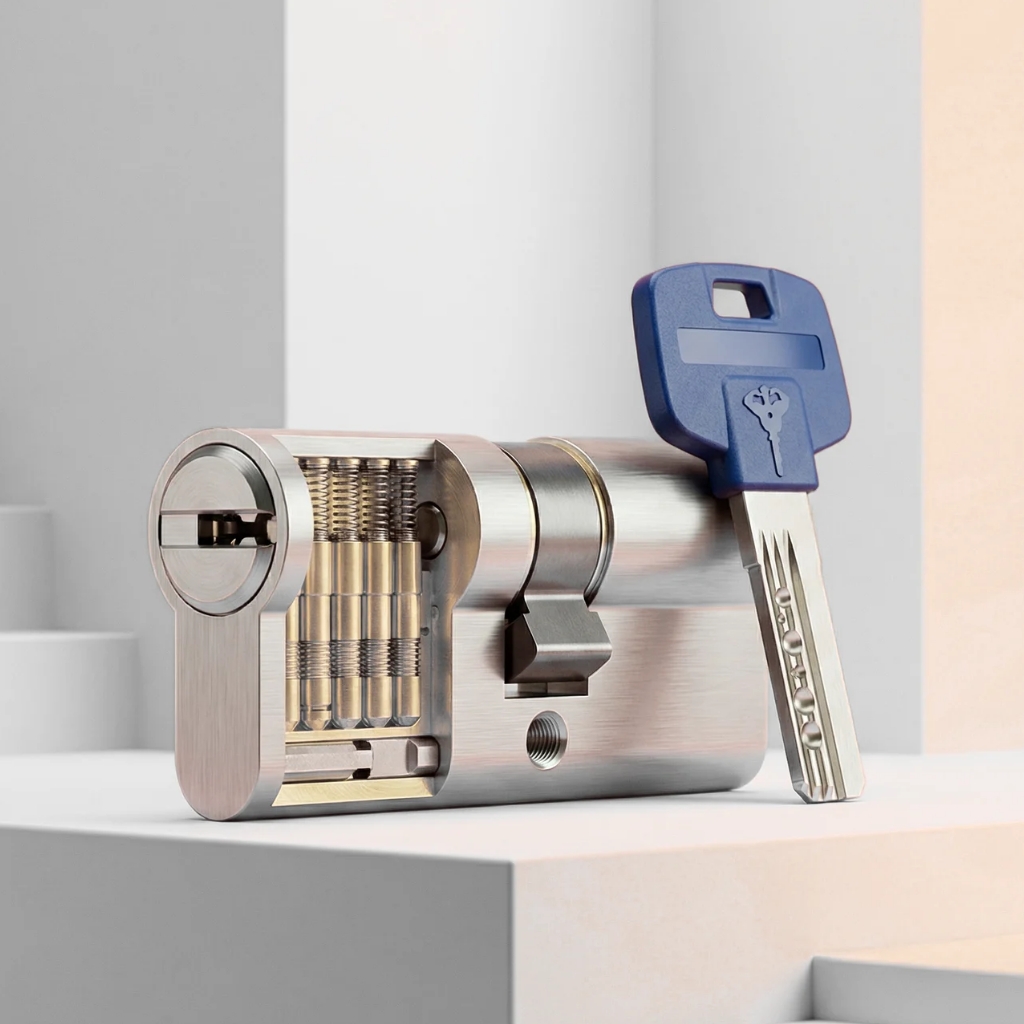
Every door in one hierarchy has to sit on one profile, so the brand is the first question on the call, ahead of the door count. Mul-T-Lock, Medeco and ABLOY are the names that come up at that end of the market, and we run blanks and cutting equipment for Medeco on the truck. One practical catch is worth knowing before we arrive: a Medeco rekey expects the original key on site, and where none exists to work from the cylinder has to be opened by pick before it can be repinned at all. Older Dundarave strata buildings bring the opposite difficulty, mortise bodies whose parts are awkward to source, and a mortise door only joins a system once the body is off and the cylinder it takes has been identified by size and cam rather than guessed at.
Caulfeild adds the constraint that decides whether a system has a future. Hardware around fifty years old there sometimes arrives tired in ways that matter to a hierarchy: tumblers worn past tolerance, a corroded housing, or a profile nobody stocks fresh blanks for any more. A level you cannot cut a new key for is a level you cannot add anyone to, which is why the profile matters more over the life of a system than the name stamped on the cylinder.
Master key system questions for the North Shore
Our building changed management and nobody has the key chart. Where does that start?
With hardware rather than with a quote. Somebody has to establish what keyway the building actually runs, whether a master is already pinned into the suite cylinders, and whether blanks for that profile can still be bought. That is a short attendance on one or two doors, and everything after it depends on the answer. Where a Lonsdale mid-rise has turned over enough owners and tenants that the key count is anybody's guess, the useful outcome is usually resetting the whole building onto one documented system, rather than repinning doors one at a time forever.
Can our suite be rekeyed without disturbing the strata master?
Yes, and it is routine in the Ambleside blocks and the Capilano townhome stratas. Your cylinder takes a new key and the building master still reaches it. Before starting we need the profile the building runs and who holds the register, since a new key record generally has to be filed with the strata manager. Shared parkade, lobby and amenity-entry fobs are a different matter entirely, because those belong to the building rather than to your unit and go through the council.
A master key has gone missing. How much of the building is affected?
Only the level that key reached, which is the argument for keeping a register. A restricted blank means the missing key cannot quietly become several, but the key itself keeps working until the cylinders it opened are re-pinned, so the job is scoped by the doors on that level rather than by the size of the building. With a register in front of us that list is a desk job. Without one it takes a walkthrough.
How long does a system take from first call to keys in hand?
A small system of four to eight cylinders usually runs two to five business days from the walkthrough to keys in hand, counting the hardware order. Larger systems, or ones on a profile that has to be ordered in, run closer to seven to fourteen days. If access has to be shut down quickly after a key event, say so on the call and it gets scheduled against that instead.
Can existing cylinders join a new system, or does everything get replaced?
Many of them join. Hardware fitted through Berkley and the Lynn Valley townhomes from the 1970s onward is mostly Schlage, Kwikset and Weiser, and cylinders for those keyways ride on the truck. Deadbolts on that stock do loosen with age, so the usual outcome is a mix: sound cylinders get repinned, tired ones get swapped. What cannot join at all is a plug with play in it, a housing corroded through, or a profile with no blanks left in circulation. Taking three doors off the plan beats building a hierarchy on a cylinder that might one day open to the wrong key.
Can you extend or take over a system we did not install?
Usually. Estates above the Upper Levels Highway are the common version of it, where a system was built for the main house and then something else acquired a door that was never keyed to anything. If the profile is current we add cylinders onto the existing hierarchy and cut authorized keys against your record. If the original supplier is long gone and the profile is dead, the honest path is a clean cutover to a keyway that is still supported, and both get priced so you can see the gap between them.